
The Hidden Cost of Manual Space Booking
Manual booking administration rarely feels expensive. A few minutes checking availability. Another few minutes replying to an enquiry. A confirmation email. A payment check. A calendar update. A cancellation. A report at the end of the month.
Each task on its own seems small.
But when those tasks are repeated across dozens or hundreds of bookings, the time can add up surprisingly quickly.
For organisations managing meeting rooms, training facilities, coworking spaces, community spaces or other bookable spaces, the real cost of a manual booking process is often hidden in everyday administration.
So how much time could your current process actually be taking?
Start With a Single Booking
Think about what happens when somebody wants to book one of your spaces. A typical manual process might include:
- Receiving the enquiry
- Checking availability
- Responding to the customer
- Confirming pricing
- Collecting booking information
- Entering details into a calendar
- Recording the booking elsewhere
- Sending payment instructions
- Checking whether payment has been received
- Sending confirmation
- Making changes if required
- Answering follow-up questions
- Producing reports later
Not every booking will require every step. But even a relatively simple booking can involve several separate interactions.
What Does 10 or 15 Minutes Per Booking Really Mean?
Imagine your team manages 40 bookings each week. If each booking requires an average of just 12 minutes of administration:
40 bookings × 12 minutes = 480 minutes
That is:
8 hours of administration every week.
Across 52 weeks, that becomes:
416 hours per year.
That is more than ten standard working weeks spent simply administering bookings. And that example assumes each booking only takes 12 minutes. For more complex spaces, the actual administration time may be considerably higher.
The Time Is Often Spread Across Different People
One reason manual booking administration is easy to underestimate is that the work may not belong to one person. One team member responds to enquiries. Someone else checks payments. Finance reconciles transactions. A facilities person updates availability. Another team member prepares reports. Because the work is distributed, nobody necessarily sees the total administrative cost.
This can make an inefficient process appear relatively harmless.
Availability Enquiries Can Be Particularly Expensive
One of the most repetitive questions in space booking is: “Is this space available?”
If customers cannot see real-time availability online, somebody within your organisation has to answer that question. And not every enquiry becomes a booking. For example, imagine your team receives 20 availability enquiries each week that do not proceed. If each one takes five minutes to check and respond to: 20 × 5 minutes = 100 minutes
That is more than 86 hours per year spent responding to enquiries that never become bookings.
Real-time availability can allow customers to answer that question themselves before contacting your team.
Payment Administration Adds Another Layer
If customers pay to use your spaces, the administrative workload can increase again. Your team may need to:
- Send payment instructions
- Check whether funds have arrived
- Match payments to bookings
- Follow up overdue payments
- Process refunds
- Manage bonds or deposits
- Record payment status
- Share information with finance
Again, each individual task might only take a few minutes. But multiplied across many bookings, the cost can become significant.
Changes and Cancellations Are Where Manual Processes Get Messy
A booking changes from Tuesday to Thursday. That may require someone to:
- Check the new date
- Update the calendar
- Update the booking record
- Notify the customer
- Adjust payment information
- Notify another team
- Change setup requirements
- Update reporting information
A cancellation may trigger an entirely different chain of actions. The more disconnected systems you use, the more places need to be updated. And every additional manual step creates another opportunity for something to be missed.
Reporting Has a Cost Too
Manual booking administration does not end when the booking is complete. Management may want to know:
- How many bookings were made this month?
- Which spaces are most popular?
- What revenue did we generate?
- Which days are busiest?
- How many bookings were cancelled?
- Which locations are underutilised?
If this information lives across spreadsheets, calendars, payment platforms and email, somebody has to bring it together.
For some organisations, monthly reporting can take hours. That time should also be included when considering the true cost of the booking process.
What About Opportunity Cost?
There is another cost that is harder to measure. What could your team be doing instead? Eight hours a week spent administering bookings might otherwise be used for:
- Customer service
- Business development
- Community engagement
- Improving facilities
- Marketing
- Supporting members
- Building partnerships
- Strategic planning
The cost of manual administration is therefore not just the wage cost of the time involved.
It is also the value of the work that is not being done.
A Simple Way to Estimate Your Current Cost
You can get a rough estimate using three numbers:
Number of bookings per week × average administration time per booking × hourly staff cost
For example:
40 bookings per week
× 12 minutes per booking
= 8 hours per week
If the average employment cost of the people involved is $45 per hour:
8 hours × $45 = $360 per week
Across a year:
$18,720 in administration time
This is only an example.
Your organisation may handle fewer bookings, spend less time on each booking, or have a very different staff cost.
The important part is doing the calculation based on your own process.
Don't Forget Unsuccessful Enquiries
You may also want to add:
Availability enquiries × average time spent responding
plus:
Payment administration
plus:
Changes and cancellations
plus:
Monthly reporting
Once these are included, the cost of the overall process can look quite different.
Does Automation Remove All Administration?
No.
And it shouldn't.
There will always be situations where customers need help, bookings require approval, or staff need to make decisions. Good booking technology is not about removing people from the process.
It is about removing repetitive administration so that people can focus on the situations where they actually add value.
That might mean:
- Customers checking availability themselves
- Booking details being captured once
- Payments being connected to the booking
- Confirmation emails being sent automatically
- Staff seeing booking status in one place
- Reports being generated from existing booking data
The aim is not to automate every interaction. It is to stop your team spending time on tasks that do not need to be manual.
The Question Worth Asking
When organisations consider booking software, the conversation often starts with: “How much does the software cost?”
That is an important question. But there is another question worth asking:
How much is our current booking process already costing us?
For some organisations, spreadsheets, calendars and email remain perfectly adequate. For others, the administrative cost of maintaining those processes has quietly become much larger than expected. Understanding that cost gives you a much better basis for deciding whether change is worthwhile.
Make Your Spaces Easier to Book and Manage
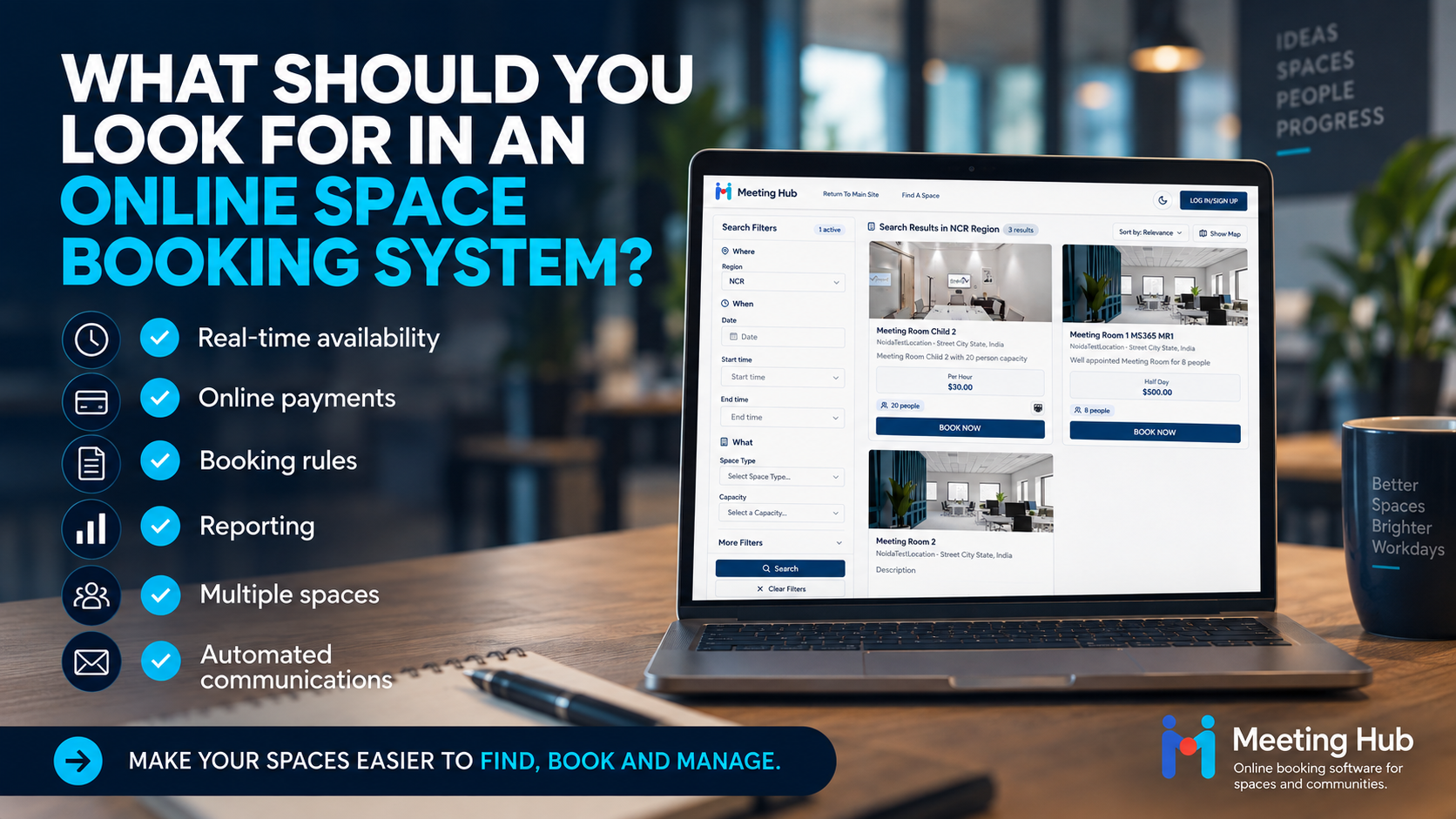
Meeting Hub helps organisations make bookable spaces easier to find, easier to book and easier to manage.
Customers can view real-time availability and complete their booking journey online, while your team retains control over booking rules, payments, communications and administration.
And when you need help, there are real people available to talk through your requirements and help solve problems.